Archive for the ‘Uncategorized’ Category

Dear Diary: Blame it on the Bellboy

Tuesday, April 27th, 2010

ddk0427

You might say that this is a not very good picture of my grandson Will — because, you’d observe, he is always so much cuter than this. Even with the milk dribbling down.

Over and over and over again, however, the beautiful pictures of Will fail to be taken, because Will knows how to throw a banana into the lens.

Prophylactically, therefore, I propose to interpret Will’s many “off” photograths as the mug shots of serious bad guys: hypothecating accountants, defalcating lawyers, and so on. Here, for example, we have Junius Q Lawsby, just back from an amortization swindle at Atlantic City  — more amazed that you wanted to take his picture than he is shy about his wide-ranging peccadilloes.

Give the kid a cigar, somebody!

Dear Diary: Rillerah

Wednesday, April 7th, 2010

ddk0407

As I was wrapping up the Daily Office this afternoon, I came across an entry at MetaFilter about the Hut-Sut Song. This was vaguely familiar, but only vaguely. By the time that I had listened to the Hut-Sut song forty or fifty times, however, I was thinking “Mormons.” Who else would support a ministry devoted to “Hut Sut rawlson on the rillerah, and a brawla, brawla sooit”? Well, maybe not even the Mormons.

I did buy four recordings of the songs from iTunes, however. Including one by Spike Jones. I have resisted Spike Jones unto my sixty-second year. Now I wish that I had kept on resisting. The only thing worse than Kathleen’s rolling her eyes is her not rolling her eyes.

In the middle of downloading all those versions of the Hut-Sut song, I took a moment to find the one tune from 1980 that Kathleen hated the most — hated the most because I liked it so much. It was “Just So Lonely” by Get Wet. They say that you can hear all your favorite songs from  high school. Fine — all of my favorite songs from high schools are total classics, even the Beach Boys’ “Be True to Your School,” which I adored at a time that was mostly devoted to learning Bach cantatas. I’m in dire need of Get Wet, and always have been.

Hearing Get Wet’s song for the first time in nearly thirty years, I wasn’t taken back in time, but rather I was reminded of what I liked about the song the first time. It’s too late to go into that now, but it has something to do with church music. Chercherz l’église would be a not unrealistic motto for understanding my taste.

We watched Pirate Radio after dinner. Kathleen gave it her hightest accolade — she fairly knighted it. Meanwhile, I thought about teaching my grandson the Hut Sut song. What a great big-band introduction! And, besides, I know that I can make “rillerah” a totally favorite code word for having fun.

Letter from France: Stuck in the Seventies

Friday, February 5th, 2010

47820985_0c5e075e0d
In the Metro, Paris. By Jean Ruaud.

Dear DB’s readers —

This is my last letter on The Daily Blague (for now), my week of guestblogging ends today. It’s time to give back the keys to our respected Editor and master of his domain. It was a good, motivating and interesting week and I have to thank RJ for the opportunity. Writing everyday in English was much more difficult than I thought and it needed something I lack: self-discipline. So it is a lesson: it’s tough to be interesting and entertaining in a foreign language everyday, even with the best of intentions. And even without having to write in a foreign language, writing a post everyday is difficult. And I call myself a blogger since 2001! I can tell you, blogging everyday, several posts and some with a bunch of interesting links in it, like RJ does, is hard work and need a lot of discipline. I can understand why RJ needed these vacations! I couldn’t do what he does here. So hats off for the Editor!

During this week I wrote these posts while listening to music and to my favorite kind: bands from the 70’s! I’m a baby boomer and the 70’s mark for me the apogee of pop and rock music! The 70’s were my adolescence years, and if I’m not very fond of my memories those were the years when I discovered that there was some nice bands to listen out there. When I discovered music. When I bought my first records to listen on my little record player. In my mind there is nothing more pleasing than the records of Steely Dan or Neil Young, Joni Mitchell or Led Zeppelin, Creedence Clearwater Revival or Fleetwood Mac, Grateful Dead or Pink Floyd, The Rolling Stones or Jefferson Airplane and countless others, the 70’s bands. The 80’s were sterile musical years (with exceptions but nothing like the fertile 70’s and late 60’s). In the 70’s I was religiously reading every month the French rock-magazine Rock & Folk from the first page to the last. I listened to Bob Dylan and Patti Smith and was dreaming of CBGB in New York, (where I had the luck to go in 1996). Somehow I’m stuck musically in the 70’s. So, it was a week listening down memory lane!

Well, hoping that you weren’t too much bored, I now leave you and return to my own blog in French (and sometimes in English), may be I’ll see you there. Bon weekend!

Regards,

Jean (jrparis-at-gmail.com)

104217916_c9fd6bb4e5
They needed the car, Paris. By Jean Ruaud.

Letter from France: Montmartre

Sunday, January 31st, 2010

33237332_f69870665b
Montmartre, Paris. By Jean Ruaud.

Dear DB’s readers —

Let’s talk about Paris. What a Parisian guestblogger is for if he doesn’t write about his city? I live in Paris intra-muros since twelve years and since my first visit here (I was ten and my uncle lived in the 16th arrondissement, close to the Trocadero gardens) I wished to live in Paris. So, it’s a dream made true, if you like. But I don’t live in posh 16th but in seedy 18th, in the north. My neighborhood, Barbès, is at the north end of Montmartre hill slopes, and is populous, multi-cultural, a bit dirty, with some traffics going on (drugs, cigarettes, mobile phones) and a lot of poverty. Why do I live here? Because the rents are low and, as I live in a somehow “gated community”, I don’t have to bother much with the neighborhood crowd.

Anyway, my neighborhood is not on the tourist tours schedules, but Montmartre, is very much. Montmartre is a tiny, quaint and beautiful neighborhood at the top of the eponym hill. From my home it’s a mere twenty minutes walk to go at the top, a steep walk with many stairs, but not a long one. From my windows I see the Sacré Coeur dome, illuminated at night. The Sacré Coeur is the most coveted tourist destination, from the esplanade in front of the basilica you have a wonderful view of the French capital. The sightseers crowd the esplanade and the Place du Tertre nearby but seldom spend the time to explore the narrow streets on the slopes. However this is my favorite place in Paris, these winding streets lined with beautiful houses, a very quiet place, not much cars, not much people, some old mills, many grand old houses, beautiful apartment buildings, little greens and a lot of little art shops and cafés, little groceries and pâtisseries. Montmartre is the place where I go when I want to take photos, and I have thousands of them in my collections.

So, if you visit Paris, even for a short time, I recommend you to walk those sometimes steep and winding little streets on the slopes of Montmartre. It really is Paris, a well preserved neighborhood, and my favorite.

Later,

Jean

2721205070_8defe30f0c
A citizen of Montmartre. By Jean Ruaud.

Loose links

Sunday, January 31st, 2010

3600927078_33f4324e291

We’ll follow sometimes during this week our respected editor’s tradition:

¶ The excellent urbanism and architecture blog: BLDGBLOG has a very strange story in “Tama-Re, or the Egypt of the West“.

¶ Owl in flight is an awesome photography.

¶ And Howling at the Moon: The Poetics of Amateur Product Reviews, is a very thoughtful analysis of a social phenomenon (I’m an amateur sociologist!).

Jean

Letter from France: Another wonderful gadget

Saturday, January 30th, 2010

3805596108_93fe66013f
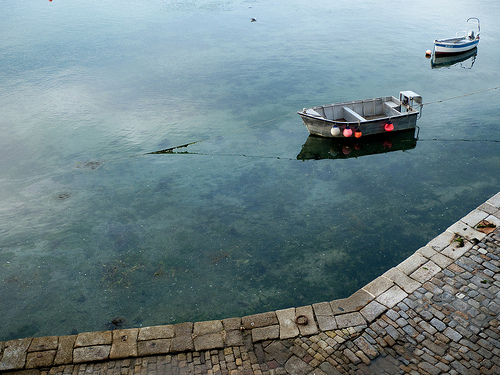
In the little harbour of Le Conquet, in France. By Jean Ruaud

Dear DB’s readers —

Hello everybody, the boss gave me the keys, let’s not wreck the place while he’s vacationing in some dismal sunny tropical island!

I’m certain that you’re aware of the two greatest week events: the State of the Union and the State of the Apple. I, in not so sunny and downright frigid France, watched both the addresses. The Apple address first, and live. The SOTU address, second, and the following evening because of this time-lag problem between the US and Europe.

I should disclose immediately that I like very much President Obama, for many good reasons, among others: he’s not my president! It is very possible that, should I be a US citizen, I would be much less enthusiastic, anyway, I like the guy and I admire his speaking talents and his intellect. I watched with interest the SOTU address but I must say, a little ashamed, that the other address (the one in San Francisco) interested me more.

So it is of the Apple announcement that I would like to talk here, today. First, I’m an Apple devotee, I own an iMac 24′ dubbed “Gros Mac”, a MacBook dubbed “Petit Mac”, an iPod classic, an iPod Shuffle and an iPhone. And I love them all insofar as you can love an appliance. I love their simplicity, their confort of use and their design. That’s the three main points. I used PCs in the past and still use one at work and I’m not adverse to using them again but I feel them cranky, too much complicated to use and too much breakdown prone. At work there are tech-supports and this is not a big inconvenience, but at home I’m my own tech-support and it’s another story. I know my way with computers and I’m able to diagnose a breakdown and mend it, but I don’t like that and I don’t like to spend my time tinkering with my computers, I’m not so geeky after all. This is why I prefer to use Macs instead of PCs, even Linux machines. And the esthetics: the Apple computers and mobile machines are always beautiful and every details are thoughtfully made. Apple is the only computer firm to employ a reputable designer, Jonathan Ive, to design its machines, and it shows. And the design is always first in the development process, the engineers have to adapt the hardware to the design not the other way round.

So, the iPad was this week announcement. I’ll not make another review here, there are roughly one million of them on the web, just stating two or three things I think as a computer user.

– The iPad seems a beautiful object and if it is as well conceived as the iPod Touch or the iPhone it will be pleasant to hold it in your hands, smooth and the right weight, a bit like a well designed book.

– The apps are compelling, iWorks is wonderful, Safari is a very good browser. The speed seems awesome.

– The prices are not to heavy (for an Apple machine, that is).

– The iBooks, well, that is single-handedly great!

– The only shortcomings I see are two: no multitasking and no Flash player. Even if Flash means a lot of CPU resources, is heavy to download and has other failings, the absence of the Flash plugging means a severe limitation when you browse the web. No multitasking means the impossibility to read, for instance, while playing music on Spotify. Or to simultaneously write an e-mail while consulting the web.

It is certain that I will buy one as soon as it is shipped, for I’m a sucker both for technological novelties and Apple products but I don’t think I need one, just I want one, and it is there where the well thought marketing magic operates: making you buy with pleasure an object you don’t really need!

Later,

Jean (jrparis-at-gmail.com)

Have A Look: Loose Links

Monday, January 4th, 2010

havealookdb1

¶ Chuck Close gets the Chuck Close treatment (scroll down). (via  reddit)

¶ The 2009 Darwin Awards.

Daily Office: Friday

Friday, December 18th, 2009

j1218

¶ Matins: Have a look at the impact of the “recession” on Ohio’s manufacturing towns. Unemployment is a national disgrace created by overzealous faith. Government may screw things up from time to time, but nobody beats financiers at catastrophe creation. (Washington Post; via MetaFilter)

¶ Lauds: Shipley, meet Ripley. Sigourney Weaver talks to Speakeasy about Avatar. She finishes with a Trick-or-Treat TREAT.

¶ Prime: British banking authorities plan to do away with checking by 2018. Our one venture in online bill-paying was a very, very expensive fiasco. We don’t write very many checks, though. (Yahoo; via Marginal Revolution)

¶ Tierce: Four really backward-looking road-construction projects. No new roads! Not for trucks and automobiles, anyway. (The Infrastructurist)

¶ Sext: In a case of what sounds like the most irregular theorizing, psychologist Peter Lovatt hypothesizes that the awkward dancing of middle-aged men serves an evolutionary purpose. All right, class. We can stop giggling now and get back to work. (Telegraph; via Arts Journal)

¶ Nones: In the Chronicle of Higher Education: Scholars Nostalgic for the Old South Study the Virtues of Secession, Quietly.” We used to think that the United States was wrong not to let the South go in 1861. Now, we’re more inclined to think that the Northeast was wrong to remain within the Union. (via The Morning News)

¶ Vespers: In this time of Best-Of lists (the year, the decade), it’s refreshing to read descriptions of nine not so very well-known books of relatively recent date that the contributors to The Second Pass think might well be highly regarded in 2110. We were particularly taken with Jon Fasman’s lines on the one book that we have read, Kazuo Ishiguro’s The Unconsoled. 

We don’t disagree. We love thinking that there will still be books in 2110 — especially after reading Helen Simpson’s “Diary of an Interesting Year” in The New Yorker.

¶ Compline: For the final Daily Office entry for 2009, we turn to that bastion of fun, The Awl, for Joel Johnson’s response to the Cringely’s cringe-worthy Christmas card, which we decided not to write up yesterday.

¶ Bon Weekend à tous!

And happy holidays as well! We’ll be back on Monday, 11 January 2010.

Dear Diary: Voter Motor

Wednesday, December 16th, 2009

ddj1216

This afternoon, I read “Green Giant,” Evan Osnos’s New Yorker piece about China’s aggressive pursuit of environmentally-aware energy strategies. The piece is no love note; Mr Osnos makes it very clear at the start that China has a long, long way to go before its atmospheres are as clean as ours. But the thrust of the story takes a longer view, and the United States suffers in the comparison. If China has improved, we’ve done the other thing.

In America, things have gone differently. In April of 1977, President Jimmy Carter warned that the hunt for new energy sources, triggered by the second Arab oil embargo, would be the “moral equivalent of war.” He nearly quadrupled public investment in energy research, and by the mid-nineteen-eighties the U.S. was the unchallenged leader in clean technology, manufacturing more than fifty per cent of the world’s solar cells and installing ninety per cent of the wind power.

Ronald Reagan, however, campaigned on a pledge to abolish the Department of Energy, and, once in office, he reduced investment in research, beginning a slide that would continue for a quarter century. “We were working on a whole slate of very innovative and interesting technologies,” Friedmann, of the Lawrence Livermore lab, said. “And, basically, when the price of oil dropped in 1986, we rolled up the carpet and said, ‘This isn’t interesting anymore.’ ” By 2006, according to the American Association for the Advancement of Science, the U.S. government was investing $1.4 billion a year—less than one-sixth the level at its peak, in 1979, with adjustments for inflation. (Federal spending on medical research, by contrast, nearly quadrupled during that time, to more than twenty-nine billion dollars.)

As I read the article, I felt that Mr Osnos was telling me useful things that, as a voter in the world’s superpower, I ought to know. But what about my fellow Americans who thought that Ronald Reagan was made of presidential timber — when in fact he was nothing more than a shill for the outlook of property owners in the Southwest United States. And what about the people who admired the second Bush, a man who made being “a shill for the outlook of property owners in the Southwest United States” sound like something much better than the worst possible president? And what about the fans of Sarah Palin, a woman who, in her contempt for genuine politics, really, really reminds me of Adolf Hitler, and who makes George W Bush take on the air of presidential sapling. What about all these omadhauns? What’s the use of reading about China’s coal gasification project if you’re yoked to utter morons?

Many people stop there — and they stop reading articles about China in The New Yorker. Me, I should like to stop being yoked to utter morons. Sarah Palan is an idiot. Once upon a time, perhaps, she was a small-town political operative, but the temptations of William Kristol and others have inflated her brain like a pink balloon of Bazooka chewing gum. It no longer computes. Anyone who thinks that she is a viable political candidate for anything more advanced than the governorship of Alaska (can we go back to being ‘the forty-eight’ one of these days?) is a backward adolescent. This assertion is no more open to argument than the proposition that reading is a waste of time, or that reality television is “democratic.” ‘

In any philosophical systems, there are axioms, points that don’t require re-argument every time something new comes up for discussion. When a given philosophical system’s axioms do need to be re-argued, then that system is either dead or dying. To anyone who argues that Sarah Palin’s views on the environment (even if I happen to agree with them) are deserving of national debate (they’re not, because Ms Palin is a barely-educated, barely-functional housewife), my reply is that perhaps it’s the axioms of our democratic franchise that we need to debate.

Even in America, the franchise is not universasl. We don’t allow toddlers to vote. We don’t allow young people between the ages of twelve and seventeen to vote — teenagers. Once upon a time, we required voters to have a certain net worth — usually, to have property worth a certain amount of rental income. We certainly don’t want to go back to that. But we desperately need a voter-qualification criterion.

How long, though, are we going to participate in a travesty of honoring the votes of jerks with potatoes where their brains ought to be? Smart people, can we think of something, before the dummies mount one of their human-pyramid spectacles and, falling over, as in their stupidity they inevitably will, crush us?  

Dear Diary: Size Matters

Tuesday, December 15th, 2009

ddj1215

It is universally acknowledged that I am an odd fellow, but the oddest thing about me, I’m convinced, is that I find MP3 recordings to be superior to CDs, just as I found CDs to be superior to LPs and tapes. I am clearly hearing something that no one else is listening for, while ignoring something else that means a lot to most other listeners.

What is so great about MP3s? Again and again, I hear new things in music that I’ve known for all of my adult life. New lines of counterpoint, rhythmic depth-charges that I’d missed. And every weekend, when I listen to operas while tidying the apartment, I understand some strange unnoticed line of Italian or German. MP3s make music clearer to me than it has ever been.

When I was young, and routinely unimpressed by the audiophile setups that I was obliged from time to time to stand before and worship, I thought that I was simply deaf, or inartistic, or missing a music receptor. This pained me only slightly, because I knew perfectly well, from more articulate exchanges, that I heard more, in the way of music, than almost everybody who wasn’t a score-reading musician. I still don’t know what all those geeky guys heard. They were certainly unable to explain it. I came to regard it as something like a sexual preference — fundamentally inexplicable.

I’m trying, at least, to express what I like about “compressed” music. It’s largely a matter of line. Think of a sketch — a few swift strokes on paper. Now think of that sketch worked into a drawing, with many, many more markings. That drawing is what I hear from my Nanos — more information, you’ll note, not less — and I’m very glad that I do. The sketch is merely vague, suggestive.

Possibly for those very reasons, the sketch is more atmospheric. Is that what’s lost in MP3 conversion? If so, I’m reminded of the old Horn & Hardart slogan: You can’t eat wallpaper. It’s nice, but it’s not the point.

If I am tired of guys repeating the lament that music downloads, while convenient, don’t sound as good as — as good as whatever superseded mode still holds their interest, it’s because they can’t be bothered to specify what’s missing. One might almost think that they’re simply missing their youth.  

When I talked this over with Kathleen, she spoke of the LP as “warm” and of the CD as “cold.” This is why I’m always inclined to put myself on the Aspie spectrum: for “warm,” I’d say “indistinct,” and, for “cold,” “crystalline.”

Nano Note: The Big Boys

Sunday, November 22nd, 2009

nanonotej11213

Last week, I finally got round to something that ought to have happened a lot sooner: I plugged a Nano dock into a right old-fashioned stereo receiver, the kind of amplifier that is connected to big speakers. And here’s the paradox: the Nano’s MP3 files are finally audible at low volumes.

I don’t really know what I’m talking about here. It could be that volumes that seem low coming from the big speakers are high coming from the Klipsch RoomGroove. (As it happens, the big speakers are by Klipsch, too). That seems unlikely, though, as the standard for ambient sound is the moment of distraction. From the very first, I’ve compared the RoomGroove sound to that of the superior table radios of the Fifties (made by Grundig, for example). It’s very good if you’re listening to it. But the big speakers are much better at playing music in the background. Doesn’t that seem odd?

Currently, the stereo systems in each of our three rooms are not connected. I plan to change that in the coming months, laying down a lot of wire and taking advantage of the right-of-way, so to speak, that was established in wiring the wireless boosters to the router. The interconnection of the amplifiers will probably spell the end of the RoomGrooves here. But I plan to change a lot of things in the coming months, so the RoomGrooves will probably be here for a while.

“Stereo system” — does anyone under 30 use that phrase? I can certainly remember a time when no one over 30 did.

Exercice de Style: "Periodic"

Friday, July 3rd, 2009

stylebanner.jpg

What do I find on page 6 of the latest from P D James, The Private Patient, but the following:

Her father’s periodic bouts of violence were unpredictable.

Oh dear. “Her father’s periodic bouts of violence were intolerable” would have been equally wrong — assuming that the father was, indeed, an unpredictable human being — but I might not have caught it. I’m amazed that no editor did. “Sporadic” would have been better; it’s at least correct. But surely way to fix this sentence is to join it with the first half of the following one:

Her father’s unpredictable bouts of violence meant that no school friends could safely be brought home, no birthday or Christmas parties arranged. And, since no invitations were ever given, none was received.

The Private Patient is really the most clever old thing. It involves (so far) a successful Harley Street plastic surgeon who runs a private clinic in the country. How’s that for up-to-date? I almost wish that Ian McEwan would bring back Henry Perowne to write a parody, because Private Patient is totally not up-to-date. It’s a wonderful old creaker. The clinic has been fitted into an old half-timbered manor house, with gates that close and mysterious rocks in the garden, where a witch was once burned. No crime has been committed — yet. A plastic surgeon in a remote country house — paging Dr Frankenstein?

update: In fact, however, the Gothic tease is soon thrown off, to reveal a ripping yarn about the consequences of plagiarism.


Weekend Update (Friday Edition): Ah men

Friday, June 26th, 2009

ddj0626

Hurray and Hallelujah! After the first installment of Lewis: Season 2, Kathleen asked for a second. So we watched that, and now it is all hours, and I can no longer remember what happened today.

Lewis, as I shouldn’t have to tell you, is the successor to Morse. Everything about the original series has been turned upside down (or at least brought up to date). Now, instead of working for a nob, Lewis has one working for him, in the person of Hathaway (Laurence Fox). The ghastly boss is a woman now, and she’s just as impossible although not quite so horribly hostile as she was in the pilot. The show leaves me trying to figure out how to go to Oxford in a non-touristic manner, such that I might be taken seriously there as a wit and a scholar, or at least as a literate American, and not as a tourist. I don’t work too hard at it, because my attempt to do the same thing on the Internet has yet to bear fruit.

***

At some point in the afternoon, Kathleen’s secretary told me how much she had loved The Hangover. I have learned that we have very different opinions about movies, and I was hesitant about recommending The Proposal, because, frankly, I don’t want to hear how somebody hated it. But perhaps it will help us settle into being one another’s Manohla Dargis: “If he likes it, I’m not even going to think about seeing it.” As soon as I got home from seeing The Hangover, I wrote a series of notes about the film. A move that made a lot of sense, you’ll say. But in fact I did it so that I could preserve my snarkiness about the movie at its ultramost. I couldn’t wait for it to end, I didn’t dislike it. That’s my story and I’m sticking to it.

***

At seven o’clock I saw that (a) I had done all the writing that could even unreasonably be expected of me and (b) I had no photographs in stock for next week’s Daily Office. So I took the tripod and the Coolpix down to Carl Schurz Park. I did not collapse the tripod beforehand but carried it fully extended —  pitifully short. I want a tripod that will see what I see, all six foot three of me. 

The Park was heaven. I couldn’t believe how pleasant it was to stand on the edge of the East River in the wake of a violent thunderstorm, snapping pictures without having to worry that they’d be blurry. I felt so free! An hour between writing and cooking — all mine. I was stoned without being stoned. Marijuana would have gotten in the way; it would also have been superfluous.

***

I have noticed, over the past couple of  years, an interesting gay trope: “He’s so attractive [on whatever level] that you either want to fuck him or to be him.” I have given a lot of thought to the “being him” option. I used to think that that’s how I felt about men I really admired: I wanted to take their place; I wanted, vulgo, to be “them.” In fact, however, the only time that I have ever wanted to be anybody else was when The Avengers was a new show, and I was in my early teens: surely there was hope that I might blossom into the kind of guy that Diana Rigg would like to hang out with.

Since then, I have certainly admired a lot of men in a covetous way. Watching Ryan Reynolds in The Proposal, I want to kick myself. It was never in the cards that I would be as generally appealing as Mr Reynolds, but appealing more particularly to people who knew me was never a problem. The problem was that I was not interested in being an appealing person, and that is what I should like to go back and change. I don’t want to be Ryan Reynolds. I just wish that I had given him some competition, as I would have done had (a) he been my age (and now old and a wreck like me) and (b) my head had not been conducting a colonoscopy. I wish that I had understood how wonderful it is to have people like you. I did not understand this when I was a teenager. I didn’t think that anybody really liked anybody. That was a cruel mistake.

***

One of the Lewis episodes was really about the Stasi. It tempted you into thinking that it was about boxing at Oxford — or maybe it didn’t; the hour was very late. But it was definitely about snitching. My fundamental existential problem is that I wish that I could stage a show trial in which all of Bronxville (the village in which I grew up) would be revealed as ghastly and hypocritical, blah blah blah; my feelings haven’t changed since childhood. But the defendants in this trial, I know, would throw up their hands and ask what they’d done wrong, even now, even today. They’d say, “what’s he complaining about?” They’re still, in the persons of their children, living the same lives today. What was wrong? I was wrong. 

Morning Read: Harry Pissalatums

Wednesday, June 17th, 2009

morningreadi07.jpg

¶ Lord Chesterfield dispenses some advice that is violently at odds with the Sixties ethos in which I came of age.

The most familiar and intimate habitudes, connections, and friendships, require a degree of good-breeding, both to preserve and cement them. If ever a man and his wife, or a man and his mistress, who pass night as well as days together, absolutely lay aside all good-breeding, their intimacy will soon degenerate into a coarse familiarity, infallibly productive of contempt or disgust.

I have had to work my way toward understanding the truth of this the hard way. I’ve gone a little farther than the earl: I believe that there is not a moment in life, no matter how solitary, that does not require the attentiveness and respect that are the pillars of good breeding.

¶ Another homily in Moby-Dick: Melville concludes a brisk chapter on the sprucing-up of a whaler after the rendering of the beast into commercial commodities with another attempt, as it seems to me, to give contemporary life an Old-Testament look, a sort of spiritual Williamsburg-ing.

… when, on the heel of all this, they have finally bestirred themselves to cleanse the ship, and make a spotless dairy room of it; many is the time the poor fellows, just buttoning the necks of their clean frocks, are startled by the cry of “There she blows!” and away they fly to fight another whale, and go through the whole weary thing again. Oh! my friends, this is but man-killing!! Yet his is life. For hardly have we mortals by long toilings extracted from this world’s vast bulk its small but valuable sperm; and then, with weary patience, cleansed ourselves from its defilements, and learned to live here in clean tabernacles of the soul; hardly is this done, when — There she blows! — thee ghost is spouted up, and away we sail to fight some other world, and go through young life’s old routine again.

Oh! the metempsychosis!

My word exactly.

¶ In the middle of the monkey-business in Chapter XXV of Don Quixote, I hit upon another passage that reminded me of the operatic sensibility that infuses so much of this book; not that Don Quixote is like comic opera, but rather the reverse: the book inspired the pace and the tone of comic opera.

What could be more Mozartean — or Verdian — than the reaction scene in which each member of the ensemble has a different response to the wonders just transpired:

Don Quixote was dumbfounded, Sancho astounded, the cousin baffled, the page stunned, the man who told about the braying stupefied, the innkeeper perplexed, and, in short, all who heard the words of the puppet master were amazed…

All these reactions are, in fact, the same, but Cervantes’ determination to come up with a different verb for each member of the company sets each slightly apart from the others, an individuation that lies at the heart of comic opera’s greatness.

¶ Squillions: In a letter from Beverly Hills dated 18 December 1955, Noël Coward retails some tittle-tattle about Clifton Webb (Waldo Lydecker in Laura):

He is leaving Clifton’s today and has taken an apartment in the same place as the boys [Charles Russell and Lance Hamilton] as we considered it unwise for him to stay here. This has caused a great fluttering in the colony and no-one knows where they’re at. He has handled the Clifton situation with consummate skill and every prospect pleases, except that it was getting near the point of no return. Poor Clifton is always on the verge of Umbrage about something or other and this this not helped by Harry Pissalatums which happens very very very often indeed indeedy.

If editor Barry Day had glossed this coy report of gay romance, and explained the meaning of “Harry Pissalatums,” he would only have been doing his job. Why he bothers to identify Russell and Hamilton but not do his job makes me throw up my hands — hardly for the first time in this inexplicably bad book.

Weekend Update (Sunday Edition): Design

Sunday, May 10th, 2009

j0510.jpg

When I look at the photograph, I think how skilled a photographer really has to be in order to make a picture that captures the beauty of a high spring afternoon beneath uncertain skies. On top of that, the few wisteria blossoms still drooping languorously from the pergola at the Conservatory Garden had faded to a dirty white. Kathleen was disappointed, and I felt guilty for having spied a beautiful display of wisteria two weeks ago, when Ms NOLA pointed it out to Quatorze and me as we left a restaurant. Now that I have seen the glorious flowerings of New York’s shrubs and fruit trees for almost thirty years, it is just about impossible to rouse myself to go to look at them on their schedule rather than my own. It’s partly that I’m simply not a naturalist.

When I look at the fountain in the picture, and the arches of the pergola, I see signs of intelligent design —intelligent human design that makes sense of the chaos in which some people inexplicably find the hand of a god. Perhaps they’re right. I should only hope that no human plan should be so psychotically disorganized as plant life tends to become only meters away from the Garden’s gardeners’ attentions. God, maybe; but intelligent god — inconceivable! Can a thoughtful mind really see intelligent design in life untended by human beings? As for the idea that human beings are the products of intelligent design — it absolutely beggars intelligence.

Wednesday last, the ladies of the Central Park Conservancy raised millions of dollars by showing up for lunch beneath a tent that stretched across the lawn. I don’t know how such fundraising works, but that comes of being too clever by half. Once upon a time, the ladies of the Park would have been godspouting moralists more concerned with rooting out fallen women than weeds. It’s to be prized that this is no longer so. I promise to become civil about God as soon as I’m sure that I won’t ever hear again about the intelligence of a divinity who would cover this vista with kudzu within a year or so of human neglect. Lock this god up in a church, where his ideas of regeneration won’t burden and wreck the vitality of the men and women around me.