Archive for the ‘Uncategorized’ Category

Gotham Diary:
Craft and Glamour
22 February 2013

Friday, February 22nd, 2013

Last night, we attended a members’ preview of the new show, making a stop from the Orsay to the Art Institute, “Impressionism, Fashion, and Modernity.” It’s a ridiculous title; I’d have called it “The Milliner’s Shop,” after the ravishing Degas of that name, a painting that fuses the three concepts in the clunky actual title in a burst of aesthetic genius. (It is in the show.) I didn’t buy the catalogue, because I never do buy catalogues at previews; one wants to think about adding yet another tome to the buckling shelves. And I didn’t want to lug it to dinner afterward. But these were poor reasons; we had dinner at a restaurant that’s on the way home, and there was no doubt in my mind that I would buy the catalogue. And not just look at it but read it. Because, thanks to some sort of quasi-fortuity, I’m primed to read about fashions of the late Nineteenth Century,  having immersed myself in readings about those of the early and mid Twentieth. I was very discontent when we did get home, because the catalogue was all that I had a mind to look at, and I felt rather like a kid who hasn’t been given an all-but-promised birthday present.

There are so many beautiful things to look at. The dresses, simply boxed in glass, are immensely chic (although not very colorful — this is a collection chosen with today’s eye), even if they are “Victorian,” and the paintings (which are colorful, although not usually because of the clothes) are all very lovely. The most immediately interesting thing about the show for me was the handful of Tissots on the walls. I haven’t seen very many Tissots; the painter doesn’t seem to have appealed to American collectors, and most works remain in Franch or Britain. I love Tissot for one reason: he relieved me of the impression that Victorian women were the ugliest creatures ever to roam the earth, dinosaurs and cookie-cutter sharks included. Tissot’s women — the ones who are decked out in the latest evening wear — are gorgeous and desirable, and, unlike their sisters in the fashion plates, thrilled to be alive. There are at least two strikes against Tissot’s claim to the first class: his ladies’ faces occasionally slip into the dreadful prettyness that was so popular in those days, and he turned out his pictures too quickly to let the paint dry properly. It’s for the latter reason that much of his work has to be shown behind glass. But I came away convinced that Tissot is an underappreciated artist, a master of sensual but unsentimental propriety. His figures aren’t stuffy because they know that they’ll be stepping out of their beautiful clothes presently — or, rather, a minute later. It was also interesting, by the way, to see a big society portrait by Carolus-Duran (not his real name), the artist who usually gets top billing as Sargent’s teacher. It’s very fine, but, my, does it show off Sargent as a genius.

There are a couple of Caillebottes, including the daring Rue de Paris, temps de pluie — daring because it’s big but drab, because its composition ought to be unsatisfactory, and because its subject is obsessively banale. It’s a picture that you have to look at for a long time to appreciate, but it’s also a picture that, in spite of everything, commands that attention. I will be getting out my catalogue (if I can find it; it’s an odd-sized book) from the 1978 show in Houston — assuredly the one event that makes me glad that I ever lived there — to refresh my grasp on Caillebotte’s extraordinary geometry. Happily, the Museum has hung Temps de pluie on a wall from which it can be seen at some distance. Caillebotte, in case you hadn’t heard, is the thinking person’s Impressionist.

Finally, there are the lovely early Monets — Luncheon on the Grass; Ladies in a Garden — wow! These are not beautiful women, but they look unexpectedly comfortable — they breathe. More than almost anyone, Monet is the master of what Henry James meant by “summer afternoon.”

To be appreciated: Manet and Renoir. The Manets in this show are unusual; or, rather, they’re usual, they look like paintings that others might have made. The figures, quite appropriately for fashionably-dressed women, do not exhibit the cadaverous cast of his more famous work. As for Renoir… I feel about Renoir the way most people feel about Tissot; his work feels kitschy to me. There is something inappropriate about the prettiness of his little girls — they’re being offered up as treats. Natives who delight by turning up in show after show, even though they live here: Mary Cassatt’s theatre-going ladies, one so sternly fixed on her opera glass, the other so cheerfully American and so surprisingly décolletée. Where do they keep it?: Béraud’s Pont des Arts on a Windy Day. “In the basement,” said our friend. “I still like it,” I replied. I want to study it as an example of how painting did not abandon realism to photography. 

Gotham Diary:
Morning Drift
21 February 2013

Thursday, February 21st, 2013


Kathleen had to be out of the house early this morning, so there would be no lingering over tea and toast. I woke up when she did, but lazed in bed, drifting in and out of states of mind, some of which were dreams. It was pleasant; I wasn’t exhausted. The morning before, I was so tired that I was afraid to face the day ahead, even though the calendar was perfectly blank. This morning, even as I dozed, I was fine with knowing that that I’d be up and about presently.

And yet, one of my first thoughts was about a good death, which I felt I was previewing, lying there in comfort. I do hope for a good death, and dread a bad one. I hope to die before the collapse of civilization that so many imaginative people these days enjoy foretelling. I am not particularly anxious that this will occur anytime soon, and I know that, meteors aside, it is very unlikely to occur as a global catastrophe. But I want no part of it, am not curious about it at all. It’s an unhealthy subject, really. I probably wouldn’t be going to see the new production of Parsifal anyway — I seem to have attained a measure of Gelassenheit about sitting through plays and concerts — but when I heard that it is set in “postapocalyptic times,” I was relieved to put it out of mind. Doomsayers are bad for morale.

Why doesn’t the word “sophology” exist, I wondered? I ran a mental finger over the bruise left by Arthur Danto’s book about art. Philosophy is the love of wisdom. Although philosophers have certainly gone in for rigorous-looking syllogisms and categories, and bristled with metaphysical lingo that frightens off the uninitiated, this love-of-wisdom does seem aptly named: it’s a pleasant pastime really. Sophology would be quite different. The study of wisdom: what would that look like? I think that it would look like Hume and James. No grand systems for them! Their wisdom begins and ends in deep humility. I would say that today’s cognitive revolution is sophologic. I would also say that I haven’t read Hume in forty years or more. Not another word out of me on this topic until I’ve done a bit of re-reading.

The other day, I pulled down a book that I thought I should re-read, Maurice Keen’s Chivalry, but it didn’t take long to doubt that I had actually read it before. If I did read it, then I’m guilty of having appropriated its contents and marked them, mentally, as my own original thinking, because as I turn the pages, I say yes, in that deep way that’s provoked by books that chime with ideas that we’ve arrived at, if so very well articulated, on our own, but that we don’t feel we’ve encountered elsewhere. There are two phenomena that suggest to me that I really haven’t read Chivalry before. I haven’t felt the low vibration of familiarity — which has nothing to do with “content” but rather registers the odd turn of phrase, the peculiar anecdote that sticks in the mind — that signals the forgotten book. And the chiming isn’t entirely harmonious. Keen and I are both extremely interested in the relation between knighthood and Christianity. Chivalry — the first half of it, anyway — assiduously traces the ultimate failure of Church leaders to interpose ecclesiastical authority into the creation of knights. My own interest takes a slightly different course: aristocratic families in Western Europe completely subverted Christianity when they saw that there was money in it, so that the “Christianity” of the knights was not much more authentic than the “christianism” on show at one of today’s mega-churches. Keen mentions here and there that Church leaders generally came from knightly families (at a minimum), but he does not really grasp that what those leaders were after was control, not reformation.  The “three orders” writings of Adalbert of Laon and Gerard of Cambrai, dating from the early Eleventh Century, were well-received precisely because they formalized a social arrangement that was already firmly in place. There were those who prayed, those who fought (“protected”), and those who worked — to feed the first two. There may have been three orders, but there were two classes.

(Only two classes. The “waning of the middle ages” began when a new, third class — a wealthy and powerful bourgeoisie — arose at the end of the Fourteenth Century, and there was nowhere, conceptually, to put it.)   

Then I had a dream. I nodded off and made a fool of myself. I bought a large orchid plant and took it to Crawford Doyle, obviously thinking to ingratiate myself in some way, or, better, to become more than just a good customer. Special! Just as obviously, I saw, as I carried the plant into the shop, how inappropriate this was. I made up a story, which neither Dot nor Lauren believed for a second (I could tell!) about having been given an “extra” orchid by a “cousin” — thus transforming my gift into refuse! Humiliation was complete when I slipped out of a shoe and saw that we were now in “my room,” the floor of which was littered with loafers and moccasins. For the last moments of the dream, I got to savor being hopeless at eighteen.

***

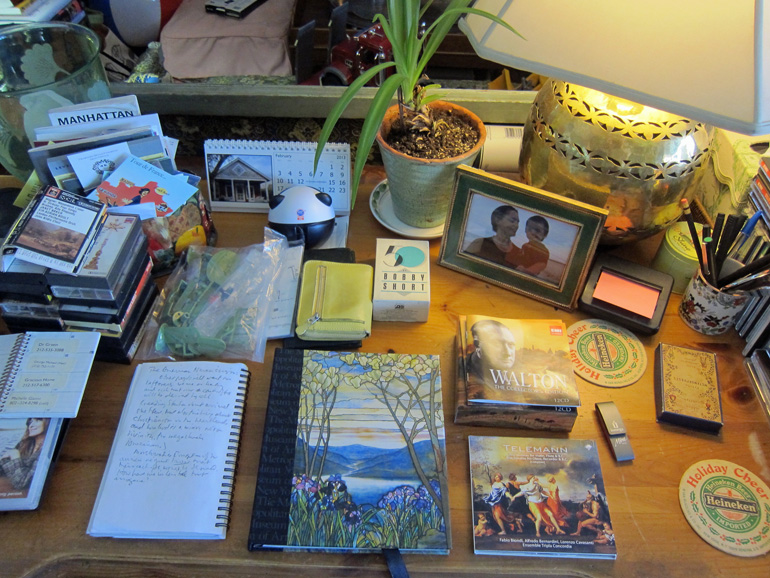
I don’t know what’s in store for today; it’s uncertain whether I’ll help out with Will’s winter break today or tomorrow. Tomorrow would be great; I will really be rested up by then. If so, I’ll deal with the too-many piles on my writing table.  

Gotham Diary:
Young Man
20 February 2013

Wednesday, February 20th, 2013

This afternoon, I took a nap. I never take naps. I took a nap in bed. By the time Kathleen left for the office, I’d been up to make her tea and toast — and then climbed back into bed. I sat up for a little while, but then got back into bed, and this was when I napped. I was that tired.

As how could I not be, the day after spending more than eight hours in sole charge of my three year-old grandson? Of course, I shouldn’t have been able to do it at all a year ago. But Will is not a toddler anymore; he doesn’t always have to be watched or worried about. I cannot always understand what he says, but conversation does happen. There is a lot of giggling and laughing. (There is also the excitement and occasional confusion of putting diapers behind.) I think that we watched five hours of Kipper. In an episode that I hadn’t seen before, Pig is entranced by some fun-house mirrors. This inspired me to dig out the tape of A Damsel in Distress, and Will watched the entire fun-house scene without distraction, often beating out the rhythm. (I see that the movie — not to be confused with Whit Stillman’s strange Damsels in Distress, has come out on DVD.)

I picked Will up in the late morning, and we went straight to the barbershop, where we didn’t have to wait long for Tito to be free. Will spontaneously followed Tito to the chair, while I stayed behind in the back, re-reading Maurice Keen’s Chivalry. From time to time, I would peek towad the front, and invariably Will would be sitting patiently and still, while Tito snipped at his mop. 

Then we walked to the Museum, where we walked a lot more. The place was packed. I wanted Will to look at two things, Homer’s Gulf Stream, which Will has seen before, and which this time elicited stern warnings from my grandson: sharks should not eat boats. They should not eat people! And the angels of the fifteenth-century Netherlands, of which the Museum has a nice collection, in old-master galleries that proved difficult to reach for one reason and another. (Is the newly-acquired portrait of Talleyrand being installed?) The other day, Will stood on a stool and watched (briefly) as I beat egg whites for an angel-food cake. That’s what set to thinking about angels, and enabling Will to make the acquaintance of some kitsch-free examples.

When we came out of the Museum, it was beginning to rain, so we had to come back to the apartment for the rest of the day. Somewhere between seven and eight, Megan appeared, and then Kathleen, and we ordered in Chinese. Will, all energy spent, fell asleep in his mother’s arms as we talked at the table.

***

I’ve been meaning to say an extra word about John Kenney’s Truth In Advertising, which was advertised in today’s Times as being on sale at select (named) independent bookshops, dont Crawford Doyle. Good! I’m glad that I don’t have to persuade Dot McClearey to stock it. The ad featured a snip from a Times review that I’d missed, if it did appear in the paper proper, by Susannah Meadows, that mentions “a surprisingly sweet romance.” This romance is the most appealing thing about Truth In Advertising, but it’s difficult to write about because it’s bashfully understated — which is no small part of the charm — and difficult to capture without quoting reams of dialogue that, out of context, might very well leave the reader — the reader of a review — feeling that you had to be there. The romance develops almost entirely on the telephone, although when Finbar Dolan, the hero, is in the same room as Phoebe Knowles, you can feel the weakness in his knees. What makes Kenney’s novel so special is the way in which true love is attained as if by ju-jitsu: Fin has only to let his bad family history drop away for Phoebe to fall into his arms. Even this is tricky to say,  because there is nothing therapeutic about Kenney’s tale, even if Phoebe is the best thing that ever happened to his hero. You have to read it.

Gotham Diary:
Reopening
28 October 2011

Friday, October 28th, 2011

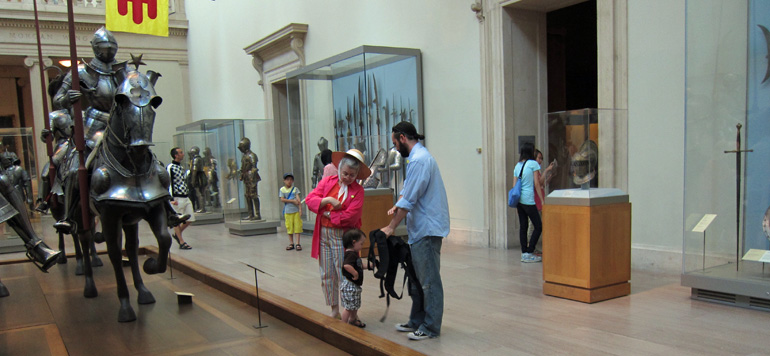
The Islamic Wing at the Museum re-opened the other night, finally, after years and years of reconstruction and refurbishment — not only of the Wing itself but of the Greek and Roman Galleries upon which it sits. I didn’t bring my camera; taking pictures would have been gauche. Once the rooms are open to the general public, I’ll snap away. For the moment, this souvenir of what I think was Will’s most recent visit to the Museum will have to do.

It’s not called the “Islamic Wing” anymore (if it ever was); it’s now the “Galleries for the Art of the Arab Lands, Turkey, Iran, Central Asia and Later South Asia.” That’s the last time you’re going to hear that mouthful from me. Holland Cotter is doubtless correct when he observes, “

Rather than presenting Islamic art as the product of a religiously driven monoculture encompassing centuries and continents, the Met is now — far more realistically —approaching it as a varied, changing, largely secular phenomenon, regionally rooted by absorptively cosmopolitan, affected by the intricacies and confusions of history, including the history that the art itself helped to create.”

But there’s no getting round the fact that this art is bound by a pervasive appreciation of calligraphy that has its roots in a highly articulate religious authority — nor the other fact, less salient within the galleries themselves but pronounced in the small graphic indicating the small corner (relative to the immense corner of the American Wing, say) of the Museum in which they sit. How do you justify sequestering all those bits and pieces from Arab Lands and Turkey and Iran and Central Asia and Later South Asia into a space that would fit within the vast chamber that houses the Temple of Dendur? Traadition is a big part of it — the same tradition that tempted the Times to run its inexcusable headline for Cotter’s review: “A Cosmpolitan Trove of Exotic Beauty.” I think that it’s safe to say that we live in times when the word “exotic” is enjoying a time-out from grown-up usage.

The other odd thing about the installation is that the most magnificent artifact in it is not only brand-new but purpose-built. The Moroccan Court is a work of art, no doubt about it, a breathtaking sculpture in plaster, tile, and wood that was completed last spring by a company of craftsman from Morocco. It is a triumph of earthen apotheosis that exploits no rare or precious resources — except, of course, the diligent inspiration of the men who built it. I’ll write later about the galleries’ treasures that appealed most to me, but for the moment I’m most taken by the new development in museum history that the Moroccan Court represents. (The Astor Court, certainly a harbinger, does not work on anything like the same “fantastically filigreed” level.) Puzzling out the nature of its novelty will be keeping a gaggle of neurons busy for a while.  

***

Will had had a long day by the time I showed up to babysit. He’d been to the doctor for his 21-month checkup (pushing 22), and he’d gone back to school for a birthday party. By 6:30, all he wanted to do was sit in someone’s lap, drink milk, and watch Sesame Street. Later, when the pizza arrived, and there were no available laps, he sat in the big chair by himself and ignored me. He didn’t want any pizza — that was no surprise — but he also didn’t want to acknowledge my presence. His focus on the television wasn’t stony, quite, but it was certainly very determined. Determined by fatigue, I believe, even if it did exactly resemble a teenager’s desperately willful obliviousness.

Then the episode came to an end, and Will perched himself on the arm of the chair, facing me, and said, “Allô.” For the first time in my experience, he said it without talking into some small device that he was pretending to be a telephone (or that might actually be a telephone). And he was saying it to me. It was like Lucy’s sign in Peanuts: “The Doctor Is In.” He got out of the chair, too me by the hand, and led me to his room, where we played with his trains for an hour. 

Another teen moment: there was a burst of violence. Out of the blue, Will picked up his train cars and threw them about the room (but not at me). When he seemed to have had enough throwing, I suggested that he’d better pick everything up. He smiled archaically and in an angel-biscuit voice said “‘Kay,” and very conscientiously picked up each one of his sometime projectiles.

A further teen moment: he fell asleep, without a fuss, while I was in the room. They used to tell me, when I was little, that I was a good boy — when I was asleep. We were somewhat surprised to learn that Will is no longer in the 99th percentile for height; he has dropped to the 97th. (Megan almost demanded a recount.) But he’s in the 99th percentile for niceness, even when he’s awake. His parents are in the 99th percentile of the leading categories as well.

Gotham Diary:
The Second Time
24 October 2011

Monday, October 24th, 2011

This time, it counted for sure. Will was wide awake throughout his second haircut, and although he eyed the two of us warily when we sat down in the barber’s chair before the plate-glass mirror, he on my knee, and held on to his bottle, he cooperated more often than he didn’t, sitting still as Tito gathered swatches of hair between his fingers and cut them centimeters at a time. Tito worked very quickly, obviously aware that his client wasn’t going to sit still (or still-ish) indefinitely. I’d have been happier if he’d taken a little more off, but he quite rightly worked around Will’s head so that the result, when time was up, would be even.

Will’s parents were very pleased.

***

I haven’t been a fan of the Times Magazine for quite a long time — I like the new, Monocle-esque design, but there is something brutish about the cover editing, and this week’s close-up of Haruki Murakami is no exception — but as does happen in almost any magazine from time to time, I found not one but two valuable pieces in this weekend’s edition. One was Mark Bittman’s master recipe for pounded cutlets. Bittman rarely has anything new to tell me, but he’s invaluable because he makes me remember and re-prioritize what I already know.  My formation culinaire, like that of so many ambitious autodidacts, was designed (by me) to enable me to impress dinner guests; if something was easy to make, it didn’t count. Bittman’s columns are balm for the recovering would-be master chef. His recipe for Chicken Scallopine al Limone was almost completely familiar — improved by replacing chicken breasts with more favorable thighs — but I somehow needed to read it and then to follow it. I marched across the street for the boned thighs and got to work. I prepped the dish and then waited for two potatoes to be done baking. Execution was a snap. I must put the recipe in the list of 25 weeknight recipes that I’m compiling. Why, you may ask? Because I rarely think about food these days when I’m in the kitchen, and when the late-afternoon moment of decision arrives (what are we having tonight?), I’m a deer in headlights. I need lists — and Mark Bittman’s variations on everyday themes — to remind me of the possibilities.

The other piece was Stephen Marche’s indictment of Roland Emmerich’s madly irresponsible new movie, Anonymous. What makes Anonymous so regrettable is the way it harmonizes with and glorifies the junk thinking that is choking Western civilization to death.  Ordinarily, making a movie in which it is posited that somebody other than Shakespeare wrote “Shakespeare” would be just a movie. But there’s more to Anonymous than counterfactual fantasy. It’s an apotheosis of our snobbish anti-elitism, as Marche observes; but it’s also a craven tribute to our hunger for celebrity self-exposure. The trouble with Shakespeare is that he doesn’t seem to have had much of an offstage life. His record, aside from a handful of legal documents, is in his work. What he thought about his work — well, that’s in there, too. What’s maddening about Shakespeare is the absence of secrecy in his life. We want to catch him keeping a private diary, an alternative to the published poems and plays; we want to see him relax and admit that “work sucks.” His exemplary discretion ought to inspire us; instead, it enrages us. And Anonymous is nothing if not a tantrum. We can only hope that brighter young viewers will be prompted to take a look at John Madden’s equally fictitious, but more reality-based, 1998 biopic, Shakespeare in Love.

In his Op-Ed piece on Anonymous, James Shapiro explained how today’s idiot conspiracy theories work. They begin with an exciting but untelligent proposition (“How could a hick from Warwickshire have written all those great plays?”) and end by asserting that the best evidence is the complete absence of evidence. Just goes to show how dangerous the secret really is! Until now, that is. Somehow (and this is never explained), the lid has been lifted, and ordinary civilians have been given a glimpse of the “truth.” I don’t know why, but I’m reminded of Linda Colley’s blithe dismissal of Freemasonry, the popularity of which throughout the Eighteenth Century (the period covered in her magisterial book, Britons: Forging the Nation 1707-1837) she attributes to “the male delight in secret rituals and dressing-up.”

Which reminds me of a third good piece in the Magazine: an excerpt (or something like) from Daniel Kahneman’s new book, Thinking, Fast and Slow. Kahneman’s contributions to what I promise never again to call Wrongology are nothing less than seminal, but what caught my eye was his approving summary of someone else’s work.

[Terry] Odean and his colleague Brad Barber showed that, on average, the most active traders had the poorest results, while those who traded the least earned the highest returns. In another paper, “Boys Will Be Boys,” they reported that men act on their useless ideas significantly more often than women do, and that as a result women achieve better investment results than men.

“Useless ideas” — would that there were no more to Anonymous than that. But, hey, it is “only” a movie. A specatacular, action-filled, delusion-infused movie.

***

Later, after dinner on Saturday night, we learned that the very inexpensive yardstick that I bought at the hardware store isn’t going to help us to measure Will’s height anymore: he tops out at a hair over a three feet. This means, as if there were any doubt, that he will almost certainly grow to be six feet tall at least; the rule of thumb is that you double a child’s height at 23 months. Or is it 25 months? Nobody can ever remember — except that 24 months isn’t it. Will will be 22 months old next week.

I missed the best part, though. While I was out of the room, Will asked Kathleen, “Where are Mama and Daddy?” His first complete sentence. That he asked her couldn’t surprise me less. If he was a little anxious about the answer, Kathleen was obviously the right person to soothe his fears. Just as his mother had known when, older to be sure, she leaned up to Kathleen as they were walking on the beach at Fire Island, and asked why “those two men over there” were kissing. Will was reassured by Kathleen’s answer, and went right back to whatever it was that he’d been doing.  


Gotham Diary:
Carental
20 October 2011

Thursday, October 20th, 2011

In the middle of Elif Batuman’s lively New Yorker piece about her fellow Harvard-alum-of-Turkish-extraction, ÇaÄŸan ÅžekercioÄŸlu, an ornithologist dedicated to the establishment of nature preserves near the Armenian border, I came across a new word, “carental.” I didn’t know what it meant, but I was too delighted to care. Surely, “carental” would open a door on even better understanding of the post-Ottoman culture that, as Orhan Pamuk never tires of rhapsodizing (in his melancholy way), has persisted through nearly a century of Kemalism. It struck me that “carental” would look like it made more sense if it began with a “k.”

I read the sentence over again. “We drank tea with a provincial governor, with a giant mustached carental agent, and with the head of the Kafkas News Agency, who shared with us a piece of breaking news…” It was thrilling, that carental was a kind of agency. All I could think of was Ben Kingsley, in Pascali’s Island — when would Batuman and her friend be shot? That all this was taking place in Kars, the once bustling but now distinctly former entrepot in the mountains of eastern Turkey, which is where Pamuk set his last novel but one, Snow (Kar in Turkish; Batumen tells us that he considered titling his novel Kars’ta Kar — Snow in Kars)  — Snow being a novel that I read whilst actually in Istanbul — well, I was beginning to wonder how T S Eliot managed to write The Waste Land without “carental.”

Then I saw the hyphen, and the second “r.”

The sad sound of air leaking from a balloon of eager expectancy reminded me of the time that Fossil Darling and I were driving through Indianapolis — an occurrence even less likely than my reading Pamuk on the shores of the Bosphorus — and, as he drove, I read a review of something appearing in, naturally, The New Yorker, and without my giving it any thought, the word “lunatic” came out of my mouth with the accent on the second syllable. “Lune-attic,” I said, and wondered what it meant. Even Fossil was befuddled — but then, he was driving. Working out the real meaning of my new word was a big let-down.

Daily Office: Vespers
Common Cause
Tuesday, 15 March 2011

Tuesday, March 15th, 2011

In a provocative post at Economix, Edward Glaeser, author of Triumph of the City, points to three issues on which city dwellers and Tea Partiers — strange bedfellows — might make common cause against the federal government’s biases.

Urbanites are not natural libertarians. New Yorkers should like government more than Montanans, because New Yorkers have more need for an effective local government.
Crowding thousands of people into a tiny spot of land creates a risk of crime and contagious disease and congestion, and those downsides of density need public management. America’s cities became healthy only when local government spent vast sums on clean water; they became safe only through massive local policing efforts.

While urbanites do need strong local governments, they can make common cause with libertarians opposed to a larger federal government, especially because national largess often goes to low-density states with more senators per capita.

The original Tea Party was a child of the city. Urban interactions in 1770s Boston helped create a revolution and a great nation.

The current Tea Party could return to its urban roots if it stands up against subsidies for home borrowing and highways and if it encourages competition in urban schools.

Moviegoing:
The Adjustment Bureau

Friday, March 4th, 2011

At the beginning of George Nolfi’s The Adjustment Bureau, David Norris (Matt Damon) is a rising young politico who’s all set to win one of New York’s Senate seats. No sooner has this been established then David’s campaign is torpedoed by the publication of a photograph of him mooning his classmates at a college reunion. As the dismal returns come in on election night, David retreats from the ballroom at the Waldorf to the men’s room, to compose his concession speech. Eventually a young woman (Emily Blunt) emerges from one of the stalls. She and David are instantly simpatico. You can tell from their banter that they belong together, and it is not surprising that they come together in a long kiss. But David has a speech to make, and before he kind find out anything about the girl, she’s capering off, with hotel security at her heels. David returns to the ballroom and gives a speech that puts his political future back on track.

Later in the movie, we will learn that Elise, the girl in the bathroom, was put there according to The Plan. Originally, in fact, she was intended to be David’s great love, but the Plan was changed, it seems, when the Planner (be patient with me) grasped that, while a dash of Elise might inspire David to make a boffo speech, a constant diet of her company would make him fat and happy, scuttling his ambitions and the prizes for which the Plan intended them. That’s why the gents from the Adjustment Bureau   — call them angels, call them agents of fate, but don’t try too hard to figure out what they are; this is just a movie — intervene when David bumps into Elise on a Broadway bus and gets her name and phone number. David was never supposed to get on that bus. He was supposed to have coffee spilled on his shirt as he crossed Madison Square Park on his morning commute, obliging him to go back home for a change, thereby missing an Adjustment Bureau intervention at the offices of his best friend, campaign manager, and new boss, a hedge fund manager called Charlie Traynor (Michael Kelly). But an adjuster who is unprofessionally sympathetic to David (Anthony Mackie) slips up, and fails to arrange for the spill. The upshot is that David gets a look, as one of the adjusters (John Slattery) puts it, behind a curtain that he didn’t know existed.

The Adjustment Bureau  is not going to please everybody — not right away. It’s going to take some viewers time and effort to see through the film’s jazzy surface to the mythic romance beneath. And even then, they may feel that mythic romance is wasted on David and Elise, not because they’re individually unworthy but because together they will probably  make a pair of mushy lovebirds.

So whether or not you find The Adjustment Bureau satisfying is going to depend a lot on how able Mr Damon and Ms Blunt are to convince you that the characters they’re playing are consumed by longing  — an undertaking that is greatly handicapped by the snappy worldliness with which this vital couple meets the world. It has been decreed by The Plan that David will move from Congress to the Senate to the White House, while Elise will blossom into the finest choreographer of her generation. Mr Nolfi asks us, in effect, to believe that old-fashioned true love could resign his two sharp cookies to careers more mediocre than stellar. The actors left no doubt in my mind that they would.

The movie’s other hurdle is the Adjustment Bureau itself — another quirky artefact from the mind of Philip K Dick. The Bureau is presented as an old-fashioned big-time insurance company, with lofty lobbies, hushed corridors, and mahogany doors. It is constituted exclusively by men who wear not only suits but fedoras — it turns out that the agents’ power actually comes from wearing the hats. Surely this no longer evokes the image of Daddy that it once did, and I wonder how much trouble Mr Nolfi is going to get into for playinig the Bureau scenes as though they were set in the 1940s. I expect that young men who see his picture will be tempted to try to rationalize his metaphysics, implausible as they are. (I wish that their cerebrations could be dealt with by adjuster Terence Stamp’s trademark understated menace.) I sat back and enjoyed the show, which consisted primarily of walking through doorways into entirely unexpected spaces; in the run-up to the climax, David, wearing one of those hats, leads Elise through a doorway at the courthouse and onto the field at Yankee Stadium, with Liberty Island the next stop. It’s visually stunning stuff that only a killjoy would sniff at.

 The current of heroic myth runs very strong in this movie. It’s a current of stories, not meanings. The Magic Flute and Die Frau ohne Schatten both came to mind, as David and Elise embraced possibly for the last time, determined not to live without their love. So did the story of Orpheus. I don’t mean to suggest that The Adjustment Bureau is an important motion picture. It’s much too early to tell how celebrated and cherished the Planner intends it to be.

What’s this? Manohla Dargis likes this movie too? That has never happened! That we agree, I mean. And I swear that I wrote this page before reading hers, discovering that she deploys “torpedo” in the very same way.

Culinarion:
Hot Oven

Thursday, January 20th, 2011

If I’m a bit worn out today, it’s because I spent yesterday in the kitchen, making a batch of tomato soup, a boeuf à la bourguignonne, and a dozen dinner rolls. Actually, I wish I knew a recipe the yielded a dozen dinner rolls, but I’ve never seen one; most yield about two dozen, which is far too many. My solution yesterday was to make a loaf from half of the dough. And what do you know? The result is much more like the better store-bought sandwich bread than anything I’ve ever made. Is it the egg? The buttermilk? Interestingly, it takes on a slightly funny flavor when toasted. And using the tall and narrow loaf pan was a mistake. This is bread that wants to be squat.

As for the boeuf… The Creuset dutch oven had been in the oven for about forty minutes when it struck me that the kitchen was too hot. I took out the stew and was dismayed to see that it was boiling. I turned the oven down, from 325º to 300º, just to jigger the thermostat spring, which evidently hadn’t budged when I’d lowered the temperature from 450º. (The 450º setting was for an eight-minute searing of the browned, flour-dusted stew meat.) Of all the times for the oven to fritz out! Happily, I was there and I caught it. But at the end of the cooking time, the results, if not nearly as dire as Julie Powell’s (in Julie & Julia), were pretty dry. What ought to have been 2½ cups of sauce came to just over half of a cup. My improvisation was to stir in a lot of beef broth and about a half cup of cream into the sauce, and boil it down. Reduced, this amplified sauce tasted good but wasn’t very thick. Nevertheless, I decided that I’d fiddled with it enough. The pearl onions and the mushrooms, cooked separately, brightened the stew’s flavor, but the meat — well, there’s no doubting that that meat has been stewed.

The tomato soup remains to be puréed. After spinning in the Cuisinart for four minutes, batches of the soup are pressed through a chinois. I’ll get to it tomorrow… or maybe the next day.

Daily Office: Vespers
The Freedom in America
Wednesday, 5 January 2011

Wednesday, January 5th, 2011

Shamsher Wadud used to run a glittering restaurant high above Central Park, Nirvana. Now he is confined to a nursing home that (as columnist James Barron notes) does not lie within the 212 area code. Blame his fall on the poor foundations of New York real estate — and on Mr Wadud’s bad judgment.  

In the tiny half-room the other day, Mr. Wadud talked about wanting to go back to Manhattan, to that different life. “But I cannot figure a way to get the place back, or the restaurant back,” he said. And what with his insurance complications and financial straits, his friends worry that he may have to move to another nursing home.

“The freedom in America in a way is very good,” he said, “but for some it is living hell.”

It must be nice to see his name in the paper, though.

Reading Note:
The Collectors’ Collector
An Object of Beauty

Tuesday, December 7th, 2010

Given the extent of my literary backlog, I could not have justified adding Steve Martin’s An Object of Beauty to the pile of novels that I hope to read at some point between now and dying. So it was all for the best that I managed to read the book before I had to decide what pile to store it in. I swallowed it whole, in one long, late, sleepy December evening, having bought it only hours before. Why did I buy it? I can tick off a few reasons. The 92nd Street kerfuffle is the querelle du jour — it’s essential to have an opinion about last week’s “interactive talk,” no matter how little you know of what actually happened. More weightily, Martin’s topic this time is art collecting, a field with which he seems to be as familiar as he is with the world of entertainment. Shopgirl, which I rather liked, is written in a clear, agreeable prose by a writer who knows how to stay out the way of his own story. Most of all, the new book’s heroine already has a terrible reputation.

An Object of Beauty tells the story of an ambitious young woman’s career in the New York art world, from the early Nineties to the present. Lacey Yeager is smart and well put-together, and she has the somewhat steely charm that pretty, clever girls from the South somewhat invariably possess. The problem is that Lacey is not very interested in romantic love. This is not her problem, of course, and neither is it a shortcoming of the novel’s imaginative world. It’s a problem because, for all that we’ve allowed women to shape their own lives in recent decades, we still expect them to value intimacy and long-term connections — and Lacey doesn’t. She is also a bit of a crook. But it is hard to disagree with the conclusion of a former lover: “I think Lacey is the kind of person who will always be okay.” And, if she’s not the most lovable character in the world, she is still admirably self-directed and disciplined. She puts looks before comfort, and she has a way of showing up late for work that highlights the previous day’s coup. I found her impossible to dislike. If pressed, I would have to say that I found Lacey’s tireless eagerness to learn very appealing.

Lacey’s tale is told by a college classmate and one-night lover, an art critic whose own trajectory is very different from Lacey’s (although at one key, “offstage” moment he serves as her accomplice). As narrative devices go, Daniel Franks is an ingenious one. He knew Lacey “when”; he found out what she was like in bed (but luckily — you can feel his relief — got back together with his girlfriend before Lacey’s “tentacles had time to attach”); and he knows her New York world. Daniel makes a informed but not exhausting cicerone to the world of auction houses, galleries, chic restaurants and small apartments that make up the art-worker’s world. He saves his observer’s loupe for the transactions, iffy at best and at least once criminal, that buoy up Lacey’s material fortunes — which, Daniel makes clear, Lacey ploughs back into her career. In one of those post-modern moments that hearken back to Defoe and Sterne, Daniel tells us, at the very end, why he has written Lacey’s story down. Not for her! 

What does Lacey want? We’re never told in so many words, but a clue that’s palpable for me is tucked into her understanding of what motivates art collectors (a passage that, we ought to bear in mind, has been written by one):

What lifted a picture into the desirable category was a murky but parsable combination of factors. Paintings were collected not because they were pretty, but because of a winding path that leads a collector to his prey. Provenance, subject matter, rarity, and perfection made a painting not just a painting, but a prize. Lacey had seen the looks on the collectors’ faces as they pondered various pictures. These objects, with cooperating input from the collector’s mind, were transformed into things that healed. Collectors thought this one artwork would make everything right, would complete the jigsaw of their lives, would satisfy eternally. She understood that while a collector’s courtship of a picture was ostensibly romantic, at its root was raw lust.”

Lacey collects collectors; more precisely, she collects moments in which collectors fall upon their “prey.” Unlike them, however, she is under no illusions about eternal satisfaction. The very idea bores her; she is like the many men and few women who don’t see the point in having sex with the same person twice. It is very easy to dismiss this kind of passion as frivolous and empty — to deny that it is a passion at all. But whether he meant to do so or not, Steve Martin graces the pages of his novel with a woman possessed by a vivid hunger for excellence. She may be pragmatically dishonest, but her sins are venial. I refuse to count her lack of interest in romantic love among them.

How does An Object of Beauty measure up as a novel? The question seems, perversely, philistine. I’m obliged to confess that I never felt the uprush of enlarged perspective that, for me, constitutes the mark of the “great” novel — but, so what? Steve Martin’s book combines the timeless excitement of a penetrating Vanity Fair profile with the insight of an exemplary novel. Because a good deal of its power comes from elision and understatement, readers will be arguing forever about whether intention or accident was the firmer guide to its composition. Discussion of “artistic merits” is premature. Lacey Yeager is truly an object of beauty.

Moviegoing:
Screwball Success
Morning Glory

Thursday, November 11th, 2010

Let’s get this straight: Morning Glory is a movie that is all about its stars. Rachel McAdams, Harrison Ford, Diane Keaton and Patrick Wilson may be dressed and housed in the manner of New York professional types, but the profession that their characters are engaged in is entertainment, and so the roles become windows through which actors of varying degrees of diva-hood are equalized on a plane of screwball entertainment. Mr Ford shows us what an awful pain in the neck he could be if he took himself seriously. (Oh, doesn’t he?) Ms Keaton plays the Julie Kavner role that Woody Allen could never bring himself to cast her in. Mr Wilson, having impersonated something of a jerk in his last picture, is back to being Mr Ordinary Nice Guy (with Beautiful Features).

And Rachel McAdams is finally the star that she has been bursting to be. She is not half of a romantic team, or the member of an unusual family. She plays a stand-alone figure, notwithstanding her character’s unobtrusive romance with Mr Wilson’s. Her Becky Fuller, a television producer, has nothing going for her but her brains and dedication. Her beautiful smile doesn’t exactly hurt, but Becky is not interested in the things that can be achieved with nothing more than a beautiful smile. She wants to succeed. She wants everything that she does to succeed, be it a little story about ballerinas or her dreams of promotion. Never have I seen a character burn with so much pure energy. In Broadcast News, to which Morning Glory has understandably been compared, Holly Hunter’s interpretation of the Becky Fuller role depended on a host of functional psychopathologies — anxieties, nervous tics, and a crippling disdain that all functioned like symbiotic intestinal bacteria: she was crazy, but she wouldn’t have gotten anywhere otherwise. There is none of that here. All of this Becky Fuller’s problems are external to her, and she solves them by imposing her own robust good sense upon them. Morning Glory is not a movie about a successful television producer who saves a faltering morning show. It’s about Rachel McAdams, making the world a better place just by being in it. That is what the great movie stars do.

As such, Morning Glory is a movie to be seen and surrendered to, not analyzed. But I can’t resist highlighting the early scene in which Ms McAdams mounts her first display of wizardry. In the telling, it will sound simple. At her first staff meeting, Becky is barraged by a fusillade of miscellaneous questions that no sane person could keep track of. The last question comes from the show’s male co-host, a creepy guy who has actually propositioned Becky and who wants to know “Why did I have to stop watching ‘Banging Granny on line’ to come to this meeting?” Becky wilts, and we’re terrified. Ms McAdams sends us a false signal: we think we can see that Becky is thinking about how to restructure these meetings so that they’re manageable. A pretty wet solution, but it’s something. We’re resigned to a standard dénouement: Becky will buy time and then go back to her office, pound her head on the wall, and wonder what she has gotten herself in for. But no sooner has Ms McAdams taken us up to the very brink of this disappointing prospect than she starts spitting back answers with all of the questions’ incoming energy, and then some. She is supremely in control, and her triumph is a joy to see. At the end, she raises her head to the co-host and tells him, by the way, that he’s fired. Does this sort of thing happen in real life? Every once in a while — and only this sort of thing. Here we have the Hollywood fantasy version, and its magic is thrillingly effective.

Then, of course, Becky Fuller’s troubles begin in earnest. Her principal problem is coaxing cooperation out of a has-been who’s on contract to her network. Once a fabled news anchor, he is more or less in the position of a buggy-whip manufacturer, too proud to retool his act. Mr Ford’s Tom Pomeroy is as intractable as a chip of Gibraltar, and the fun of Morning Glory is watching Rachel McAdams use all the body English at her command to move him, in tiny, squeaking pushes, to where she needs him to be.

Screwball comedies let us laugh people who think that they can’t stand one another discover the awful truth that they can’t live without one another. Morning Glory extends this proposition to the world of work. Becky, Tom and Colleen Peck (Ms Keaton’s co-host) interact without the faintest latency of romance. (It would be a stretch to regard Tom as a father-figure for Becky; she’s pretty much beyond father figures.) Instead of the promise of love, Becky brings the promise of success, and it is her own success that finally kindles Tom. Which is as it should be: in the great fairy tales, nothing succeeds like success.

Morning Snip:
Exemption

Tuesday, September 14th, 2010

¶ Clyde Haberman in the Times: “Everyone’s Really Mad; Almost Mad Enough to Vote.” The important line in this litany of iratitude is the last one.

Everybody seems to be mad as hell.

Carl P. Paladino, running as a Republican for New York governor, can’t stop saying how mad as hell he is.

Mark Levine, a Democrat running for a State Senate seat from parts of Manhattan and the Bronx, mailed a campaign brochure showing a man and a woman with faces hideously contorted by rage — that’s how mad as hell they are.

New Yorkers testifying at a series of hearings that began Monday night can be counted on to tell the Metropolitan Transportation Authority over the next few weeks that they are mad as hell over proposed fare increases.

Former Mayor Edward I. Koch, who has never found a limelight he cared to avoid, has gadded about the state telling the electorate to get mad as hell at Albany and “throw the bums out” if they don’t agree to a batch of political changes he proposes.

Out in Modesto, Calif., homeowners have banded together saying they are mad as hell over property taxes.

An editorial last week in The Wyoming Tribune-Eagle urged people to get mad as hell over their school system.

The title of a new book about the Tea Party is “Mad as Hell,” which is what Tea Party types keep saying they are.

Several groups unhappy with the blitz of new airline fees have proclaimed Sept. 23 “Mad As Hell Day!” Presumably, without that exclamation point we would not grasp how really and truly seething they are.

One group seems to be exempt as a target for this free-flowing rage. Nobody ever says to voters that it may be time for them to get mad as hell at themselves.

Morning Snip:
East Is?

Monday, August 23rd, 2010

From Philip Greenspun’s Weblog:

“Are you on the north or south side of the highway?” I asked the first clerk, a man.
“There is no north or south. We’re in the same shopping plaza as Bertucci’s,” was the reply.
“If Rt. 9 is oriented east and west, doesn’t that mean that there would have to be north and south sides of the road?” was my follow-up.
“I don’t know anything about north or south,” came the reply.
“Boston is to your east,” was my next attempt to orient the guy, “as is the Atlantic Ocean and Europe.”
“Now you’re being rude to me,” sulked the clerk.

Housekeeping Note: The Daily Office will appear at 6 PM.

Out & About:
Mostly Mozart 2010 (II)
16 August 2010

Monday, August 16th, 2010

The second and final evening of this year’s rendezvous with Mostly Mozart — a recital by the Emerson String Quartet at Alice Tully Hall — was not as delightful as the first. I’m convinced that it was the sight of a Con Ed emergency van parked outside our building, over the subway station construction site, that made me fretful as I headed for the West side. What would I come home to? Walking up seventeen flights of stairs? When the concert was over, the first thing I did, after calling Kathleen, was to call home, and, hopefully, to hear my voice on the answering machine. Everything was fine. But fretfulness spoiled the concert a bit.

As did the couple seated to my left, who, just before the second movement of Mozart’s Clarinet Quintet, moved over one seat. I have no idea why, but of course I assumed that there must be something offensive about my person. There was certainly something offensive about my sports jacket. I’d just had it back from the dry cleaner, and yet here was this strange blob of blue on the lapel.

Fretful.

The program began with five fugues from Bach’s second Well-Tempered Clavier collection that Mozart scored for string quartet in 1782, when he was new in town (Vienna) and a protégé of Baron van Swieten, possibly the most important connoisseur in the history of Western music. Mozart makes the point of the adaptation very clear: Bach’s dense polyphony is spaced out over four instrumental parts that make it much easier for fashionable listeners to grasp. I know more about this music than I know it itself, so I can’t say offhand if the fugues were played in a set order or simply chosen from a larger group. Either way, the sequence was satisfying, with the slowest and gravest of the fugues coming in fourth place, followed by something suitably finishing.

This was followed by one of Mozart’s best-known quartets, the Dissonant, in C, K 465. There is nothing at all dissonant about the music, once Mozart has had his fun in an edgy prologue that must have alarmed a few conservative listeners (Mozart was by now new-ish in town). Happily, I long ago recovered from the snobbish feeling that the Dissonant is too familiar to attend to (although I do still vastly prefer K 464, in A, but just as a matter of love). I have known every note since undergraduate days, when there was nothing remarkable about such a statement. Unfortunately, there was nothing remarkable about the Emerson’s performance. It was very good, and the audience loved it, but I wanted something more — edgy. Not more dissonant, saints preserve us. (There were at least two egregious out-of-tune notes as it was.) But more interesting dynamically. (Meaning: more sharply articulated variations of loud and soft, fast and slow, fluid and staccato, and all the other opposites that make Mozart so bottomlessly interesting.) The Emerson, frankly, looked old. They played a quartet that they have had down for too long.

After the interval, clarinetist David Shifrin brought the group to a more exciting prospect, for Mozart’s very great Clarinet Quintet in A, K 581 — as, perhaps, did a switch between the violinists; much as I hate to think so, the Dissonant may have sagged for me because second violinist Philip Setzer was given an ill-advised chance to play first. Certainly Eugene Drucker, the quartet’s usual primo, played with a melting beauty during the retarded section that precedes the zippy conclusion of the Quintet’s finale. As for Mr Shifrin, he reminded me from the get-go that the Quintet was a work that Benny Goodman learned to play in his Hull House youth and recorded in his jazz prime. Mr Shifrin’s execution perhaps a trifle too impeccable to bring the Battle of the Bands to mind, but he certainly winked and sparkled. As always, I was furious with Mozart for not repeating the sublime conclusion to the Larghetto’s exposition. I always look forward to hearing this music again at the end, and I am always madly disappointed.

Especially when I’m already fretful.

Gotham Diary:
Known Unknowns

Tuesday, June 22nd, 2010

When I was young, I didn’t understand inertia, the juggernaut tendency of things to go on as they are. Most young people have no desire to reckon with inertia, but I wasn’t one of them; I’d have been relieved to know how powerful it is. Now that I do understand it, it’s my only hope for the future of civil society. The other difference between then and now is that the world was so much less self-conscious fifty years ago. Attention is being paid, and in spades, these days — but to what? I’m astonished and appalled to see how many bright young people still believe that the contemporary corporation, no matter what its line, can be meaningfully checked by law. But I don’t shout about it too loudly, because I wouldn’t like to encourage the idea that corporations are bad and must themselves be outlawed. Nothing is so simple, one way or the other.

For the next few days days, maybe longer, smart people are going to betray themselves by talking about Errol Morris’s new suite of entries at Opinionator. This time, his topic is “unknown unknowns” — the things that people not only don’t know about but aren’t aware of not knowing. Mr Morris’s example is the melting point of beryllium: he doesn’t know what it is, but he knows that. Many people don’t know about beryllium or even melting points. What, for smart people like Mr Morris, Jason Kottke (who picked up the first entry), and me, constitute the unknown unknowns? It seems to me that Errol Morris has bumped into a perfect description of the learned mind: one that’s aware of the unknowns. The smartest person is the one who can demonstrate that he or she knows less than anybody else, simply by rattling off a list of known unknowns.

Right there, you can see why I’m pinning my hopes on inertia to prevent a general psychosis, as bright people everywhere completely rejigger their idea of what it means to know about the world, effectively repolarizing it: it’s not what you know, but what you know you don’t know. Crazy!

The other day, I linked to a very long discussion at The House Next Door, about the merits of two classic films about the agony of ageing, Sunset Boulevard and All About Eve. Given the drift of their discussion — they preferred Wilder to Mankiewicz — I was not surprised that neither of them had felt obliged (or cautioned) to look into the identity of Sarah Siddons, after whom the theatrical society so prominent in the movie’s framing device is named. If they had, then they might have had an idea of who is represented in the picture on the wall that seems to have puzzled them. The Wikipedia entry for Sarah Siddons would have shown them: Sir Joshua Reynolds’s Sarah Siddons as the Tragic Muse. In that case, their conversation would not have been saddled with this wrongfooted rambling:

It’s entirely possible, of course, that the painting is quite famous. I freely admit that my knowledge of that art form is limited. Furthermore, I recognized Toulouse-Lautrec’s Aristide Bruant dans son cabaret hanging in Margo’s living room (hence, she likes famous art). So perhaps you know exactly what that slow zoom reveals, and maybe I should, too, and maybe that’s why neither of the two commentary tracks on my DVD makes any mention of the zoom or the painting. Then again, unless the painting is as recognizable as Mona Lisa, I find the haste with which Mankiewicz cuts away from the painting, after going through the effort to (a) hang it there and (b) zoom in on it, to be baffling. Giving Mankiewicz the benefit of the doubt—and thanks to my close examination of the painting on my computer—I’ll assume that the painting symbolizes Karen’s place between an angel she sees (Eve) and a kind of demon she doesn’t (Eve again). Still, I think it’s telling that one of Mankiewicz’s few attempts at cinematic storytelling is essentially mumbled.

The painting may not be as well known as Mona Lisa, but it was certainly familiar to the sophisticated members of the audience to whom All About Eve is pitched. The people who, afterward, would have been able to explain to anyone not only the identity of the painting but its bearing on the drama. Who was Sarah Siddons? What is the Tragic Muse? Why not a comic muse? Tastes change, certainly, it’s perhaps unlikely that today’s sophisticated viewers (under forty) will be familiar with this painting. Jason Bellamy is aware of that. His known unknowns include the identity of this painting, which might be “quite famous.” It’s his unknown unknowns that bother me: he doesn’t seem to know that the name of the Sarah Siddons Society might mean something in a movie about actresses. When I was in school, we were taught to treat such crumbs of information as clues, because, in a successful work of art, every detail was made to tell.

Then along came the booming racket of mass culture, which is interesting only to the extent that sophisticated youngsters have ironized it. (Even then, not so much; there’s rueful note of “you had to be there” to the satire). I am not going to unpack Joseph Mankiewicz’s references, scattered there and there, to a great Eighteenth-Century actress (the first century in which there were great actresses). There is nothing occult about them, really, once you stop to think and tease things out. Just for starters, the painting underlines the tension between an actor’s private and professional lives, a tension so sprung on what seemed to simple minds to be lying and deception that actors were denied Christian burials until fairly modern times. This tension electrifies every moment of All About Eve. Surely the great satisfaction of the movie’s climax (set in New Haven) is the discovery that Eve Harrington has been even more deformed  by it than has Margo Channing.  

Once upon a time, it would have been depressing to learn to learn that, in effect, you didn’t know anything. After all that schooling! It wasn’t easy to find things out, and it was rarely interesting. Today, however, that’s less true — less true than it was yesterday, and a lot less true that it was before the Internet was developed. What may keep us from completely losing our minds, as we tune in to a world of known unknowns, is the search engine, which has already acquired a formidable inertia of its own.

Reading Note:
At the bottom of the garden

Thursday, June 3rd, 2010

ddk0603

The pleasures of reading Barbara Pym’s A Glass of Blessings are simple but amply sustaining. There is the lapidary writing, marinated in understatement, and a corresponding tact: Pym has very clear ideas about what’s right, what’s wrong, and what’s funny, but she is determined to avoid communicating them directly to her readers, some of whom, she trusts, will share her outlook without having to be cued. (Those who don’t will either be bored, puzzled, or — the lucky ones — intrigued.) You know that you’re going to be a fan of Pym’s artistry if the following exchange elicits not a laugh but a broadening smile:

“I don’t like knitting,” I said.

“No, I despise women who are always knitting,” said Sybil. “But it can be a useful occupation — the kind of thing one can do when talking.”

“I wonder if women brought their knitting when Oscar Wilde talked,” said Piers.

“I daresay not,” said Sybil calmly, “but that doesn’t mean they wouldn’t have liked to.”

There is the handsome figure of Wilmet Forsyth, the young married lady of modest leisure who narrates the book, along with the delightful suggestion that Wilmet is something of an unreliable narrator. It’s not that she has something to hide, but rather that she has something to learn. Her lesson is bound up in the poem that gives the book its title.

In George Herbert’s four-stanza, sixteen-line poem The Pulley, God pours the contents of a glass of blessings over newly-created man. Having bestowed strength, beauty, wisdom, honor, and pleasure, God holds back on the blessing at the bottom of the vessel, which is that of rest, so that the other virtues will be enjoyed “with repining restlessness.”

Let him be rich and weary, that at least;
If goodness lead him not, yet weariness
                 May toss him to my breast.

Wilmet Forsyth does not repine, but she is restless, and the novel opens with a double-barreled temptation. At church one morning, she spies the brother of her best friend, an interesting disappointment called Piers. Then, after the service, she learns that a new assistant priest will be arriving soon. Ingenuously unaware of the dangers to her heart as well as to her respectability, Wilmet dallies flounderingly with both men. As it happens, they’re both, while fond of her — fond perhaps because she is married and unattainable — interested in other people. At the end of the novel, Wilmet realizes that her life is indeed as blessed as it can be. (That her staid-seeming husband, Rodney, has also found his attentions wandering serves to strengthen the marriage, but it also helps that his mother, Sybil, decides to remarry, and to reclaim her house for herself, forcing the young couple to do what they ought to have done at the start.)

There is the pleasure of Pym’s ecclesiastical comedy. Three sorts of players occupy this uniquely English stage: the high-church clergymen, addressed as “Father,” the respectable ladies of the parish who expect the clergymen to remain celibate, and the laymen who bring to the more elaborate liturgies an expertise that savors more of military competence and commercial savvy than of spiritual piety. It is an utterly worldly church that is, pre-eminently, the hub of its parishioners’ lives, which unspool not in some charming county village but in what seems to be Bayswater. It might strike today’s reader as odd that a moderately fashionable and respectable young married woman, without children, plans her life around morning mass and parish receptions, but it would be a mistake to suppose that Wilmet is less religious than the churchgoers around her. Almost as though the Reformation had never happened, these people regard the church as a fount of meaning and familiarity. They have little interest in the doctrinal underpinnings, and rather expect the church to act as a buffer that protects the everyday from the transcendent.

There is also the pleasure of watching a lady novelist handle gay life candidly, at a time when homosexual acts were proscribed in England, and to do it without resorting to any simplifying terminology. When Wilmet divines that Keith, Piers’ beautiful but socially inferior flatmate, is more than a friend, she absorbs the blow to her vanity without a drop of nasty moralizing. 

I got into the taxi and we waved goodbye. I could not imagine Piers going back to the house, climbing the stairs, perhaps sitting down heavily in an armchair, letting out an exaggerated sigh, while Keith’s flat little voice began discussing me, criticizing my clothes and manner. I felt battered and somehow rather foolish, very different from the carefree girl who had set out across the park to meet Piers. But I was not a girl. I was a married woman, and if I felt wretched it was no more than I deserved for having let my thoughts stray to another man. And the ironical thing was that it was Keith, that rather absurd little figure, who had brought about the change I thought I had noticed in Piers and which I had attributed to my own charms and loving care!

Also rather gay is Wilfrid Bason, a reject from Rodney’s office who serves the parish priests as a housekeeper for a while. He’s a very sophisticated cook, but he’s also something of a thief — at least, he likes to borrow other people’s pretty things. That’s the extent of Bason’s outrageousness, but given this novel’s mild climate, he fairly screams his way through it. Pym shows him off as a ridiculous person, but without the faintest suggestion that he’s representative of his team.

Finally, there is the benediction of Pym’s great good nature. In a conventional novel, the following passage might adorn the expository beginnings, but in A Glass of Blessings it works rather more like a climax.

I tried to make myself useful but there was very little for me to do. The weather was glorious, but it seemed wanton to be lying in a deckchair in the mornings while Mary was arranging things for the coming retreat, so I took an upright canvas chair, or sat on a hard wooden seat of the kind that looks as if it might have been given in memory of someone. I half expected to see an inscription carved on the back. The only task Mary could find for me was to pick and shell some peas for lunch, and to put the pods on the compost heap under the apple trees at the bottom of the garden. Here, in a kind of greenish twilight, stood a pile of grass cuttings and garden rubbish, and as I added my pods to it I imagined all this richness decaying in the earth and new life springing out of it. Marvell’s lines went jingling through my head.

My vegetable love should grow
Vaster than Empires and more slow….

There seemed to be a pagan air about this part of the garden, as if Pan — I imagined him with Keith’s face — might at any moment come peering through the leaves. The birds were tame and cheeky, and seemed larger than usual; they came bumping and swooping down, peering at me with their bright insolent eyes, their chirpings louder and more piercing than I had ever heard them. I wondered if people who came here for retreats ever penetrated to this part of the garden. i could imagine the unmarried mothers and the schoolboys here, but not those who were striving to have the right kind of thoughts. Then I noticed that beyond the apple trees there was a group of beehives, and I remembered the old saying about telling things to bees. It seemed that they might be regarded as a kind of primitive confessional.

I went slowly back to the lawn, but to a deckchair now; the hard wooden seat seemed out of keeping with my mood.

Dear Diary: Paradise — the Rental

Tuesday, May 25th, 2010

ddk0525

It’s awful. I’ve re-read yesterday’s diary entry several times, but if I didn’t remember what I thought I was writing about — a memory that’s completely independent of the words that I set down here — I wouldn’t know what I was trying to talk about. My excuse for avoiding specifics was that specifics would be deadly dull to read about. In fact, they’d have been even duller to write about. I was taking it easy. Sorry.

If I weren’t old and calloused, I’d nourish the hope that tomorrow or the next day might be just like today. But days like today happen once a month at best, doubtless because I’m a stupid dolt who doesn’t understand his own rhythm. I was busy all day, and on many different levels. I wrote up two reading items, the New Yorker story (a chunk of Jonathan Franzen’s new novel — exciting to read but a disappointing displacement of genuine short fiction) and Operation Mincemeat. I uploaded seven or eight CDs onto the pop-side laptop (the desktop is cordoned off for the classics), and edited the very eccentric playlist that wakes me up every morning. The paperwork that I did was not very serious but it wasn’t frivolous, either — a new medium. I read a lot; I started, finally, to read Steve Pincus’s 1688, a book that I’ve been dying to take up for months but that I insisted on setting aside until I’d finished Peter Wilson’s Thirty Years War. I did a number of little kitchen things, culminating in a very nice dinner of veal piccata, a dish that I haven’t made in over twenty years. Call it beginner’s luck: it was delicious.

I sorted out our Manhattan Theatre Club tickets. Don’t as me why, but Kathleen arranged for this year’s tickets to be held at the box office or in the patron’s lounge of MTC’s venues, with the result that I’ve had no idea of dates. It’s a good thing that I took care of this today, because Kathleen bought seats for Red that conflict with one of our MTC subscription evenings. All fixed.

I wrote a few letters, and I had a good talk with the Web designer who is helping me with the “tablet edition” of The Daily Blague. He’s also helping me with the tablet edition of Portico, a site to be known as Civil Pleasures. Getting these two sites up and running is the minimum required assignment of this spring break. I can’t wait to see this column of text fill the iPad screen from side to side.

So it wasn’t a day of mindless bustle; nor was it a day of “writing.” Thanks to the heavenly weather, I felt as though I were spending the day in paradise. A paradise where I have to clean up and pay the bills, true. But even more of a paradise for that very reason.

I’m looking forward to tomorrow. After a morning at home (the Book Review review, can we?), I’ll head out on a round of errands that will begin at Perry Process and Staples, carry me to Williams-Sonoma, and perhaps deposit me at the Museum. (And I know that I’ve already forgotten something here!) There may even be a croque monsieur for lunch.

New Yorker Story: Roddy Doyle's "Ash"

Wednesday, May 19th, 2010

ddk0519

This week’s New Yorker story, Roddy Doyle’s “Ash,” reads more like the instructions accompanying a kit than a piece of fiction. Assemble its fragments of dialogue and its (for the most part) short paragraphs of the protagonist’s thoughts and actions as best you can — the proper order has been taken care of, but you must supply the voice and the affect. How better to write about an Irishman with affect issues? About feelings and self-awareness in a culture that (still?) contemns feelings and self-awareness, inducing everyone of the male persuasion to find the lowest livable emotional settings.

That such inhumane self-policing makes you stupid is established right away.

We’ll still be friends, she said.

— Grand, he answered, and then he was walking down a street by himself, before he understood what had happened.

That “what had happened” turns out not to have happened — that Ciara, Kevin’s wife, having assured him that they’ll still be friends after she abandons him (and their two daughters), gets cold feet and comes creeping home — is what happens in “Ash.” The wife does not, in the end, leave her husband. We have no idea why, and, because Ciara is not a particularly attractive person, we don’t much care. We’re happy at the end because little Erica and Wanda won’t be growing up without their Mammy — not yet, anyway.

Most of what intervenes between Ciara’s departure (strung out over several nights) and her return is telephonic communication between Kevin and his brother, Mick. “Kevin was starting to dislike his brother, but this wasn’t a new feeling.” There are no new feelings in this story, which bears a startlingly recent date-stamp: at the end, the volcano in Iceland explodes, grounding all the airplanes in Europe. One can only wonder who was expecting to see his or her own short story published in the May 24 issue, and how he or she has dealt with the rescheduling.

“Ash” is compulsively readable — there’s no denying that. But it is also tripe.

Dear Diary: Loisaida Headline

Tuesday, May 18th, 2010

ddk0518a

Will turned over. Onto his tummy. All by himself. He did it yesterday for the first time, but I saw it for the first time today, and, when I did, I spontaneously/unthinkingly applauded.

And then Will turned over again. And again. And again. He wasn’t interested in his bottle at all.